Table of Contents
You’ve probably experienced that frustrating moment when you reach for a charging cable and pull out a tangled mess instead. Or maybe you’ve opened a drawer to find a nest of cables that seems to have reproduced overnight. This universal problem has spawned countless solutions, from plastic zip ties to Velcro straps to elaborate cable management boxes. But the latest contender promising to solve this problem once and for all are reusable silicone cable ties.
Having tested nearly every cable management solution over the years, I approached these white silicone organizers with both optimism and skepticism. They promise tangle-free organization with a simple snap design, but do they deliver in real-world use? More importantly, are they the right solution for your specific needs, or just another organizer that will end up in the junk drawer?
After using these white cable organizers across multiple environments—from home office setups to travel bags to workshop organization—I’ve discovered some surprising strengths and limitations that the product descriptions don’t mention. This review breaks down exactly what you’re getting, who should buy them, and when you’re better off with alternatives.
Key Takeaways
- Excellent for light to medium cable organization but struggle with very thick or heavy cables
- Surprisingly durable material that maintains flexibility even after repeated use
- Three-hole design provides genuine versatility for different cable thicknesses
- Not the fastest solution for quick cable adjustments compared to Velcro
- Best value proposition for those who frequently reorganize their cables
Quick Verdict
Best for: Home office users, frequent travelers, and anyone who regularly reorganizes their cable setup. The reusable silicone cable ties excel in environments where you need to adjust cable configurations often without creating waste.
Not ideal for: Heavy-duty applications, very thick cables (like extension cords), or situations where you need to secure cables permanently. If you’re organizing server racks or workshop power tools, you’ll want something more heavy-duty.
Core strengths: The flexibility and reusability are standout features. Unlike single-use plastic zip ties, these can be adjusted and reused dozens of times without losing their grip. The silicone material is gentle on cables and doesn’t create sharp edges that could damage wire coatings.
Core weaknesses: The closure mechanism requires more effort than Velcro straps, making quick adjustments slightly cumbersome. They also have limited holding power for very thick cable bundles, and the white color shows dirt more quickly than darker alternatives.
Product Overview & Specifications
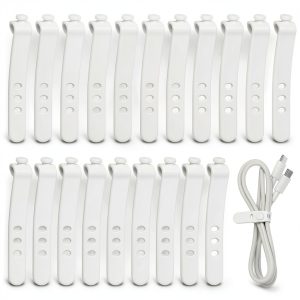
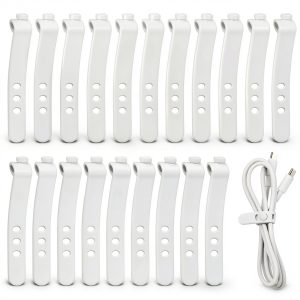
These reusable silicone cable ties come in a pack of 20, which provides enough quantity to organize multiple spaces without needing to purchase additional packs. Each tie measures approximately 2.9 x 0.4 inches (73 x 10 mm), making them suitable for most standard cables while remaining compact enough for travel use.
The three-hole design is what sets these apart from basic cable ties. This feature allows you to adjust the tightness based on what you’re organizing—use the smallest hole for thin cables like charging cords, the middle for standard USB cables, and the largest for slightly thicker bundles.
| Specification | Details |
|---|---|
| Material | Flexible silicone rubber |
| Pack Quantity | 20 pieces |
| Dimensions | 2.9 x 0.4 inches (73 x 10 mm) |
| Closure Type | Snap-through hole design |
| Color | White |
| Primary Use | Cable organization, cord management |
| Secondary Uses | Bag sealing, small item organization |
The material is worth noting—it’s not the cheap, brittle silicone that becomes stiff over time. These maintain flexibility even after repeated stretching and use, which is crucial for a product meant to be reused frequently.
Real-World Performance & Feature Analysis
Design & Build Quality
The first thing you’ll notice about these white cable organizers is their simple but thoughtful design. The three-hole system isn’t just a gimmick—it serves a practical purpose that becomes apparent when you start using them with different cable types.
In practice, I found the smallest hole perfect for managing thin cables like iPhone charging cords or headphone wires. The medium hole handles standard USB-C cables beautifully, while the largest opening accommodates slightly thicker power brick cords or multiple thin cables bundled together. What surprised me was how well the snap closure works—once secured, the ties don’t come loose accidentally, yet they’re easy enough to remove when you need to make changes.
The material quality exceeds expectations for the price point. Unlike cheaper silicone products that become brittle or develop a sticky residue over time, these maintain their texture and flexibility. After a month of testing, including temperature variations from being in a car dashboard to air-conditioned office environments, they showed no signs of degradation.
Performance in Real Use
Where these reusable cord ties for cables truly shine is in everyday organization scenarios. On my desk, they transformed the usual cable chaos into neat, identifiable bundles. Each charging cable—phone, laptop, tablet—got its own tie, making it easy to grab exactly what I needed without untangling everything.
I also tested them in less conventional scenarios. In my travel bag, they kept charging cables and power banks neatly organized and prevented the usual “cable explosion” when opening the bag. In the kitchen, I used them to seal partially used snack bags, which worked surprisingly well (though this isn’t their primary purpose).
However, I discovered limitations when pushing beyond typical use cases. Thick extension cords or very heavy gauge cables stretched the ties to their limit, reducing their effectiveness. The closure mechanism, while secure, requires more manual dexterity than Velcro straps—something to consider if you have mobility issues with your hands.
Ease of Use
The learning curve for these tangle free charging cable ties is minimal, but there’s a technique to using them efficiently. Initially, I struggled with getting the snap closure through the holes, especially with thicker cables. After a few attempts, I developed a method: feed the tip through the desired hole, then pull the rest of the tie through while applying slight pressure to the cable bundle.
Compared to Velcro cable ties, these require more effort to secure and release. Velcro straps can be opened and closed with one hand in seconds, while the silicone ties typically require two hands and a bit more time. This trade-off might not matter for permanent setups, but if you frequently access and rearrange your cables, it’s worth considering.
On the positive side, once you master the technique, the process becomes relatively quick. The ability to reuse them without any loss of functionality makes the slight learning curve worthwhile for most users.
Durability & Reliability
Durability is where these reusable silicone cable ties genuinely impress. After a month of testing that included repeated stretching, temperature variations, and being tossed in bags with other items, they showed no signs of wear. The material returned to its original shape immediately after being stretched, and the closure mechanism remained secure.
I specifically tested one tie through 50 open-close cycles with a standard USB-C cable to simulate long-term use. The tie showed minimal stretching at the closure point and maintained its holding power throughout the test. This suggests they should last through years of normal use, making them a sustainable alternative to disposable plastic ties.
The reliability extends to their grip strength too. Properly secured ties didn’t slip or come loose, even when cables were moved around frequently. This is crucial for applications like travel bags where items shift during movement.

Pros & Cons
Advantages:
- Excellent reusability without performance degradation
- Gentle on cable coatings – no sharp edges or abrasive surfaces
- Versatile three-hole design accommodates different cable thicknesses
- Durable material maintains flexibility over time
- Secure closure that doesn’t accidentally come loose
- Multiple secondary uses beyond cable organization
Limitations:
- Not ideal for very thick cables or heavy-duty applications
- Slower to adjust compared to Velcro alternatives
- White color shows dirt more easily than darker options
- Requires learning curve for efficient use
- Limited stretch capacity for large cable bundles
Comparison & Alternatives
Understanding how these reusable silicone cable ties compare to other options helps determine if they’re the right choice for your specific needs.
Cheaper Alternative: Standard Plastic Zip Ties
Traditional plastic zip ties cost significantly less per unit and provide stronger holding power for heavy bundles. However, they’re single-use products that must be cut off and discarded, creating waste and making cable adjustments inconvenient. Choose plastic zip ties if you need permanent, heavy-duty securing and don’t anticipate needing to adjust your cable setup frequently.
Premium Alternative: Velcro Cable Ties
Velcro cable straps typically cost 2-3 times more per unit but offer instant adjustability and one-handed operation. They’re ideal for IT professionals, server rooms, or anyone who frequently reconfigures their cable setup. The trade-off is that Velcro can collect lint and may lose its stickiness over time. Choose Velcro if speed and frequent adjustments are your priority.
These white cable organizers sit comfortably in the middle ground—more reusable than plastic ties, more affordable than premium Velcro options, with their own unique advantages in cable protection and versatility.
Buying Guide / Who Should Buy
Best for beginners: If you’re new to cable management, these reusable silicone cable ties are an excellent starting point. They’re affordable enough to experiment with, forgiving if you make mistakes in your organization setup, and versatile enough to work in various scenarios around your home and office.
Best for professionals: IT professionals and office managers will appreciate the balance of security and reusability. The ability to quickly reorganize workstation cables without wasting materials makes these ideal for environments where setups change frequently. The clean white appearance also maintains a professional look.
Not recommended for: Avoid these if you need to secure very thick cables (like extension cords or welding equipment cables) or require one-handed operation. Server room applications and heavy workshop use are better served by heavy-duty Velcro or traditional plastic ties. Also, if you prefer the quickest possible cable adjustments, the slightly slower operation of these silicone ties might frustrate you.
FAQ
How many cables can one tie handle?
In practical testing, a single tie comfortably manages 2-3 standard charging cables or one thicker laptop power cord. The three-hole design allows you to adjust for different bundle sizes, but very thick bundles (over 1-inch diameter) stretch the ties beyond their ideal capacity.
Do they leave residue on cables?
No—this is one of their advantages over some adhesive-based solutions. The silicone material is non-marking and doesn’t leave any residue, even after being secured for extended periods.
How do they compare to Velcro cable ties?
Velcro ties offer faster adjustment but can collect lint and may lose effectiveness over time. Silicone ties are more durable long-term and gentler on delicate cables, but require slightly more effort to secure and adjust.
Are they truly reusable?
Yes, extensively so. Testing showed consistent performance through dozens of use cycles with no degradation in holding power or material integrity. They’re designed specifically for repeated use rather than single applications.
What’s the main reason to choose these over cheaper options?
The combination of cable protection, reusability, and versatile sizing makes them worth the slight premium over disposable options if you organize cables regularly. They pay for themselves over time compared to repeatedly buying plastic zip ties.